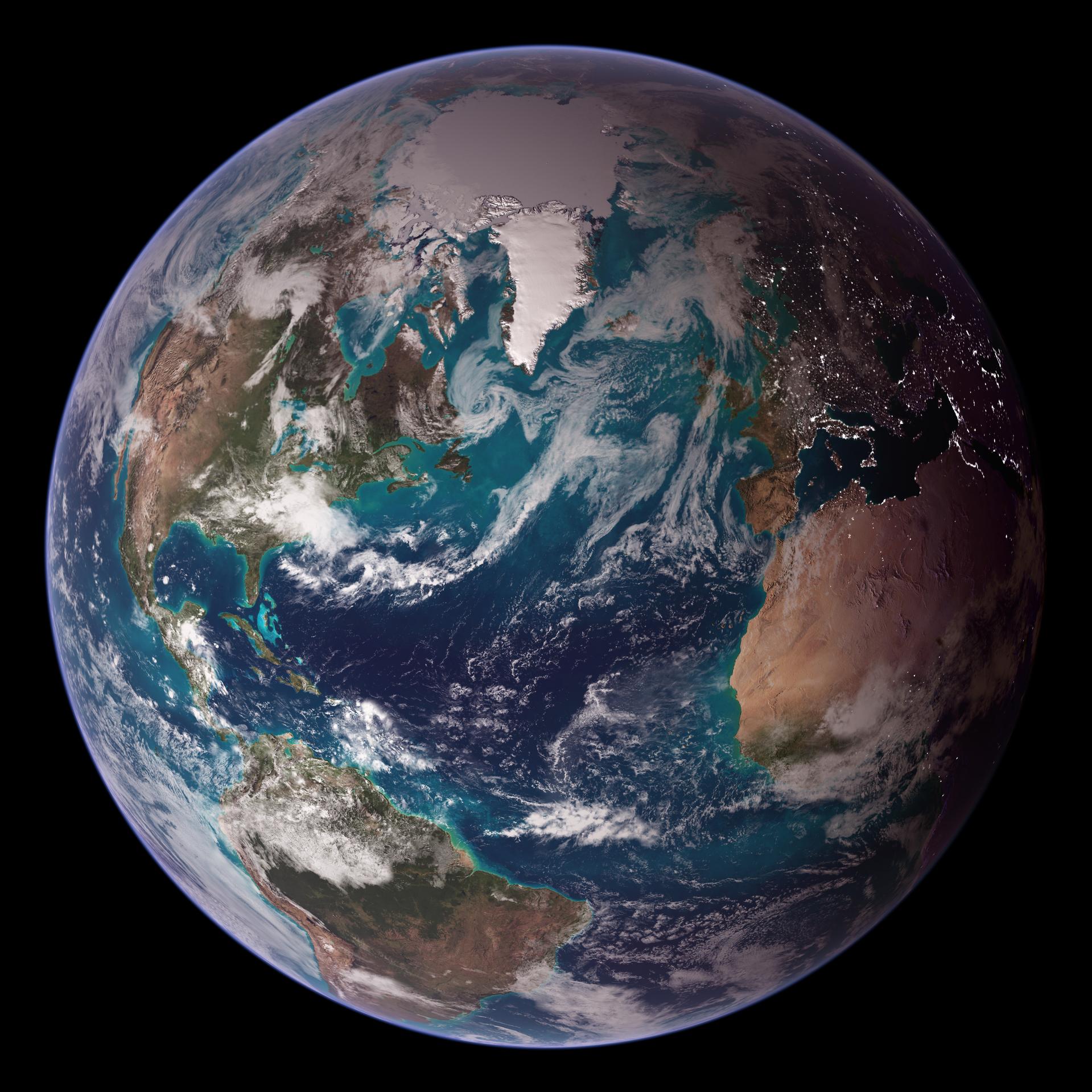
Earth works through connections, not isolated parts.
The global ocean covers about 71 percent of the surface and stores, moves and exchanges heat, water and carbon. Its interaction with the atmosphere, ice, land and living systems shapes conditions experienced everywhere.
OBSERVEDLiquid surface ocean, active geology and a life-altered atmosphere
INTERPRETEDA tightly coupled planetary system with powerful feedbacks
NOT PROVENThat any single observation explains the full climate or biosphere
This is a planetary orientation. Kodmart's deeper Earth module will later connect places, ecosystems, history and practical missions without compressing them into one page.
QUICK PLANET PROFILE
Build the world before chasing the mystery.
Use these values as orientation, then follow the linked mission files when precision matters.
POSITION3rd planet
The inner edge of the Solar System's outer rocky-planet region.
YEAR365.25 days
The quarter day is why calendars need leap-year corrections.
DAY23.9 hours
Earth's rotation sets the daily rhythm of light and weather.
RADIUS6,371 km
The largest of the four rocky planets.
OCEAN71% of surface
Connected liquid water moves heat, carbon and nutrients.
MOONS1
The Moon stabilizes and records parts of Earth's early history.
OFFICIAL MISSION FILES
Wonder with the source still attached.
Each briefing separates measurement from interpretation and links to NASA or ESA material. Open the source whenever a claim matters.
01 · OCEAN
Most of the surface is connected water
The ocean covers about 71 percent of Earth and contains about 97 percent of its water.
A useful science page should not end by pretending the mystery is closed.
QUESTION 01
How do feedbacks change the pace of warming?
Clouds, ice, oceans, vegetation and carbon cycles can amplify or reduce change.
NEXT EVIDENCE
Long, calibrated records across atmosphere, ocean, ice and land.
QUESTION 02
How resilient are connected ecosystems?
Stress in one region can propagate through migration, water, climate and supply networks.
NEXT EVIDENCE
Local observations joined to global, long-term ecological records.
QUESTION 03
How unusual is a long-lived inhabited planet?
Earth is the only case where life, geology, ocean and atmosphere can be studied together.
NEXT EVIDENCE
Better histories of early Earth and comparative observations of rocky exoplanets.
FIELD NOTES
Four details worth carrying into the next room.
A global average never replaces local conditions.
One image is a moment; climate requires a calibrated record through time.
Earth observation combines instruments with different resolutions and wavelengths.
The deeper Kodmart Earth module connects planetary context to places, nature and history.
PLANETARY READING ROOM
Read Earth as evidence, not as a collection of trivia.
These original briefings combine mission data, peer-reviewed research and clearly labelled interpretation. They are written for Kodmart; the linked records remain the authority when precision matters.
01
ONE CONNECTED OCEAN
Earth's climate memory is stored largely in moving water.
The ocean is not background scenery. It transports heat, exchanges carbon and links weather to changes that unfold over decades.
More than seventy percent of Earth's surface is ocean, and roughly ninety-seven percent of the planet's water is held there. Its high heat capacity allows it to absorb and redistribute enormous amounts of energy without changing temperature as quickly as land or air.
Currents move heat between latitudes and depths; evaporation couples the ocean to clouds and rainfall; ice changes reflectivity and salinity; ecosystems alter carbon and oxygen cycles. A useful Earth page therefore has to connect measurements rather than treating one temperature, storm or satellite image as the whole planet.
A global average does not erase regional change.
Ocean heat can influence the system long after it is absorbed.
Weather describes events; climate requires patterns through time.
Climate conclusions are built from independent records, physics and explicit uncertainty.
Confidence is not a popularity score. It reflects the agreement, quality and limitations of multiple lines of evidence.
Surface stations, ocean floats, satellites, ice cores, tree rings and other archives observe different parts of the Earth system. Models then test whether known natural and human drivers can reproduce the magnitude and pattern of change. The strongest conclusions survive across methods that have different weaknesses.
The IPCC assessment process evaluates published research and states confidence and likelihood rather than hiding uncertainty. Its conclusion that human activities have unequivocally caused global warming does not mean every local impact is known exactly; it means the causal conclusion is supported by converging evidence while regional ranges remain part of the result.
Uncertainty is quantified information, not an admission of ignorance.
Attribution compares observed patterns with competing causes.
Assessment reports synthesize research; they do not replace the underlying studies.
Blue Marble · NASA Earth Observatory · real mission imagery, presented with its source attached
KODMART EVIDENCE PROTOCOL
How to inspect a planetary claim.
1
Name the instrument.
What was measured directly, at what wavelength and from where?
2
Separate the image from its processing.
Is the color natural, enhanced, mapped from another wavelength or simulated?
3
Keep alternatives visible.
Which explanations remain consistent with the observation?
4
Ask what would change the conclusion.
Which repeat observation, sample or mission could discriminate between them?
Blue Marble · NASA Earth Observatory · evidence-reading view
SOLAR SYSTEM MISSION ATLAS
Choose the next world without losing your route.
Every planet and the deep-space flight opens a separate sourced reading mission. Distances and sizes in the cockpit remain visually compressed.
MISSION STATUS · KNOWLEDGE REMAINS OPEN
Earth is not the baseline because it is simple.
It is the baseline because it is the only planet where we can compare remote sensing, direct measurement, deep history and living consequences at once.