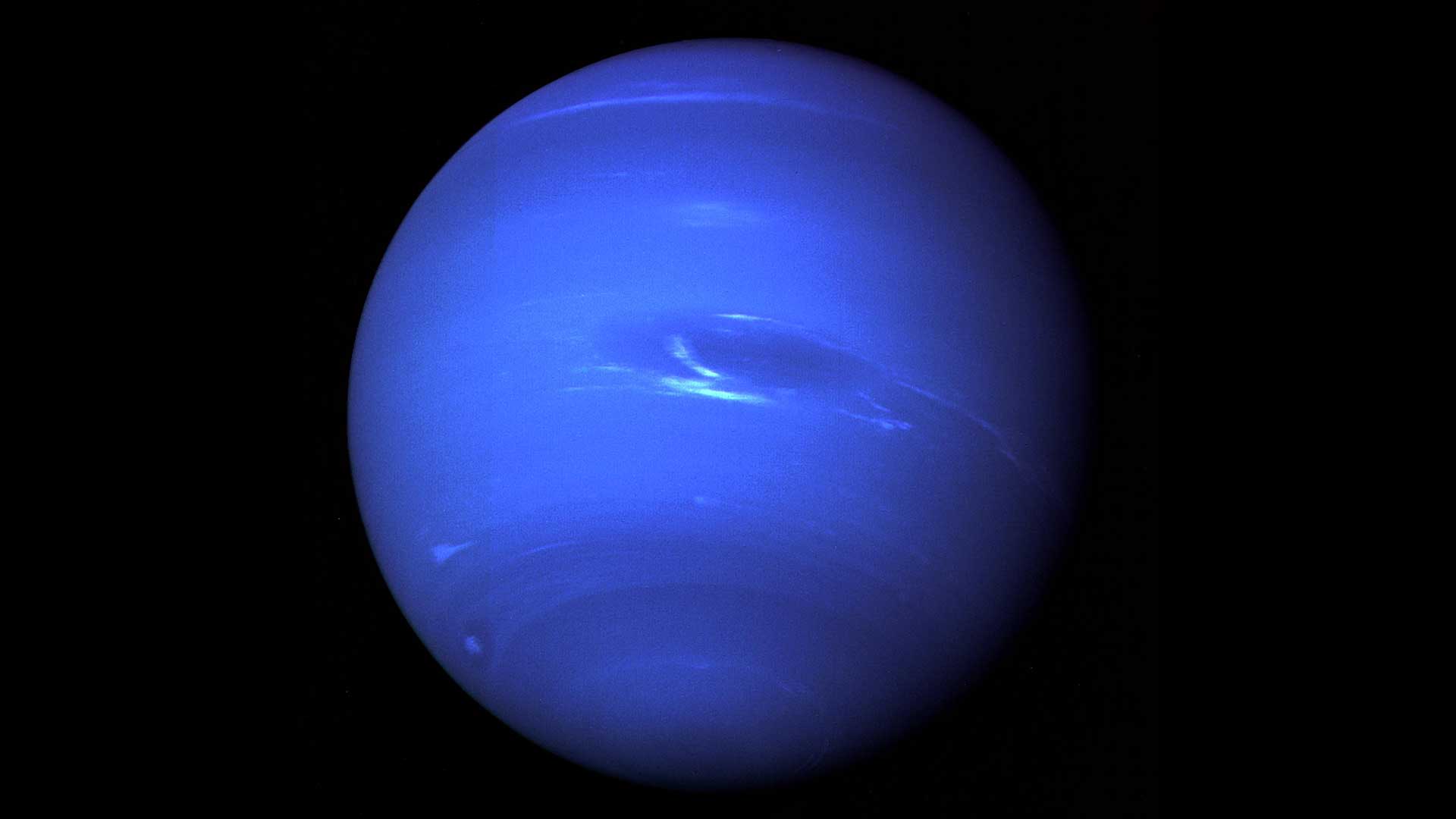
Neptune radiates more energy than it receives from the Sun and supports fast winds and evolving storms. The exact transport of internal heat through the atmosphere remains an active problem.
OBSERVEDStrong emitted heat, high-speed winds and transient dark vortices
INTERPRETEDDeep internal energy helping power atmospheric activity
NOT PROVENA complete model for storm formation and disappearance
Enhanced images can exaggerate Neptune's blue; its color and weather must be interpreted with instrument and processing details visible.
QUICK PLANET PROFILE
Build the world before chasing the mystery.
Use these values as orientation, then follow the linked mission files when precision matters.
POSITION8th planet
The most distant recognized planet in the Solar System.
YEARAbout 165 Earth years
Neptune completed its first known orbit after discovery in 2011.
DAYAbout 16.1 hours
Fast rotation helps organize powerful atmospheric flow.
RADIUS24,622 km
Slightly smaller than Uranus but more massive.
SUNLIGHTAbout 4 light-hours
Only a small fraction of Earth's sunlight reaches the planet.
VISITSOne spacecraft flyby
Voyager 2 passed Neptune and Triton in 1989.
OFFICIAL MISSION FILES
Wonder with the source still attached.
Each briefing separates measurement from interpretation and links to NASA or ESA material. Open the source whenever a claim matters.
01 · DISTANCE
Sunlight takes about four hours
Neptune orbits roughly 30 astronomical units from the Sun and completes a year in about 165 Earth years.
A useful science page should not end by pretending the mystery is closed.
QUESTION 01
What drives such fast winds?
Neptune receives little sunlight yet maintains vigorous storms and extreme atmospheric motion.
NEXT EVIDENCE
Long-term heat-flow and depth-resolved wind measurements.
QUESTION 02
How did Triton become captured?
Its backward orbit suggests a violent event that reshaped Neptune's original moon system.
NEXT EVIDENCE
Better surface ages, interior constraints and orbital-history models.
QUESTION 03
How do ice giants form?
Uranus- and Neptune-sized planets are common elsewhere, but local examples remain poorly sampled.
NEXT EVIDENCE
Entry probes and orbiters measuring noble gases, gravity and deep composition.
FIELD NOTES
Four details worth carrying into the next room.
Neptune's vivid blue is often enhanced in processed imagery.
A dark spot is an atmospheric vortex, not a mark on a solid surface.
Triton probably formed elsewhere before capture.
Distance limits data rate and mission opportunities, not scientific importance.
PLANETARY READING ROOM
Read Neptune as evidence, not as a collection of trivia.
These original briefings combine mission data, peer-reviewed research and clearly labelled interpretation. They are written for Kodmart; the linked records remain the authority when precision matters.
01
WEATHER FAR FROM THE SUN
Neptune receives little sunlight and still drives some of the fastest winds known.
Its storms expose a planetary energy problem, not merely a spectacular color palette.
Voyager 2 saw dark vortices and bright companion clouds in a vigorously moving atmosphere. Later telescope observations showed that dark spots can appear and disappear, demonstrating that they are weather systems rather than permanent marks on a surface.
Methane absorbs red light and contributes to the blue appearance of both ice giants, but it does not by itself explain every difference between Uranus and Neptune. Internal heat, haze particles, cloud depth and atmospheric circulation all participate, and color processing must be disclosed when images are compared.
A dark spot is a vortex, not a solid feature.
Image color depends on wavelength and processing.
Weak sunlight does not mean a motionless atmosphere.
Six close hours cannot resolve a planet that takes 165 years to orbit the Sun.
Neptune and Triton remain a system reconstructed from one flyby and long-distance monitoring.
Voyager 2 provided the only close spacecraft measurements of Neptune, its rings, magnetic field and largest moon. Triton's backward orbit indicates capture, while its young-looking terrain and plumes point to an active history that may have reorganized the original moon system.
An orbiter with an atmospheric probe could measure noble gases, gravity, magnetic structure, heat flow and change through time. These are not interchangeable observations: together they constrain where the planet formed, how material is distributed inside it and why Uranus and Neptune evolved differently.
A captured moon can preserve a history from elsewhere in the Solar System.
Interior models remain degenerate without gravity and composition data.
Ice giants are common exoplanet sizes but poorly sampled locally.