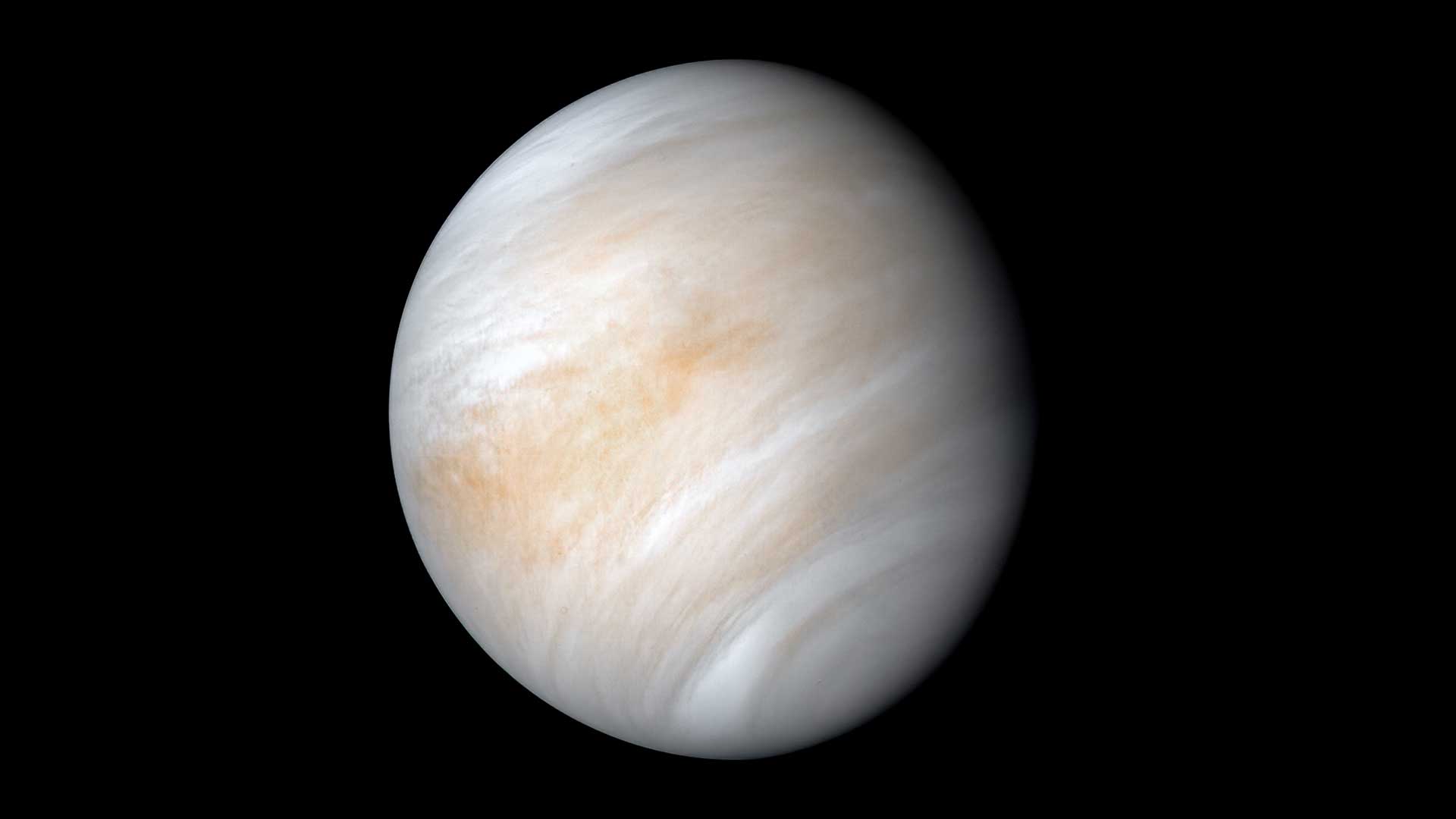
Venus may still be changing beneath an atmosphere that hides its surface.
Reanalysis of Magellan radar images identified a volcanic vent that changed shape between observations. It is strong evidence of recent activity, but Venus still needs modern repeated measurements to reveal how active it is today.
OBSERVEDA radar-imaged vent changed shape and apparent area
INTERPRETEDLikely volcanic activity during the Magellan mission
NOT PROVENThe global eruption rate or a complete modern activity map
A changing vent supports active geology; it does not resolve every proposed atmospheric or biological signal.
QUICK PLANET PROFILE
Build the world before chasing the mystery.
Use these values as orientation, then follow the linked mission files when precision matters.
POSITION2nd planet
Earth's nearest planetary neighbor for part of each orbit.
YEAR224.7 Earth days
A Venus year is shorter than its axial rotation.
ROTATION243 Earth days
It turns slowly and in the opposite direction to most planets.
RADIUS6,052 km
Nearly Earth's size, making the different climate especially valuable.
PRESSUREAbout 92 bar
Surface pressure is comparable to deep ocean conditions on Earth.
SURFACEHot volcanic plains
Radar sees through clouds that hide the ground in visible light.
OFFICIAL MISSION FILES
Wonder with the source still attached.
Each briefing separates measurement from interpretation and links to NASA or ESA material. Open the source whenever a claim matters.
01 · GREENHOUSE
The hottest planetary surface
A dense carbon-dioxide atmosphere traps heat, producing average surface conditions hot enough to melt lead.
A useful science page should not end by pretending the mystery is closed.
QUESTION 01
How active is Venus today?
Changing radar features and atmospheric signals suggest activity, but the global rate is unknown.
NEXT EVIDENCE
Repeated high-resolution radar and atmospheric measurements.
QUESTION 02
When did the water disappear?
The answer separates a brief early ocean from a longer temperate period and tests climate models.
NEXT EVIDENCE
Atmospheric isotope ratios and ancient surface chemistry.
QUESTION 03
Why does the atmosphere rotate so quickly?
Clouds circle the planet far faster than the solid surface turns.
NEXT EVIDENCE
Long-duration wind, wave and cloud observations at many altitudes.
FIELD NOTES
Four details worth carrying into the next room.
Do not confuse cloud-top temperature with surface conditions.
Radar brightness is not ordinary visible color.
A chemical detection is not automatically a biological detection.
Venus is a climate comparison, not simply an 'evil Earth'.
PLANETARY READING ROOM
Read Venus as evidence, not as a collection of trivia.
These original briefings combine mission data, peer-reviewed research and clearly labelled interpretation. They are written for Kodmart; the linked records remain the authority when precision matters.
01
A PLANET BEHIND CLOUDS
Venus forces science to reconstruct a surface that visible light cannot see.
Radar, atmospheric chemistry and gravity must be combined because no single instrument can tell the whole story.
Venus is close to Earth in size, yet its surface sits beneath a dense carbon-dioxide atmosphere and global sulfuric-acid clouds. Radar can map landforms through the cloud deck, but brightness changes with surface roughness, slope and viewing geometry. A bright patch is therefore evidence to interpret, not an automatic photograph of fresh lava.
Modern Venus science is designed around connections: interior heat can drive volcanism; volcanism can alter atmospheric gases; the atmosphere controls surface temperature; and weathering can change what radar sees. ESA's Envision mission is built to observe those layers together rather than treating geology and climate as separate worlds.
Radar brightness is not ordinary color.
Different viewing angles can imitate surface change.
Atmosphere, surface and interior must be tested together.
The case for present-day volcanism is strong enough to test — and still debated.
Two scientific readings of the same Magellan archive show why method and uncertainty belong beside the headline.
A 2024 peer-reviewed analysis compared Magellan radar passes and interpreted changed backscatter near volcanic features as new lava flows. The result supports a geologically active Venus, but it depends on comparing observations made with different geometries and instrument conditions.
A later critique argued that incidence-angle effects and regional geology could reproduce the signal without an eruption. This does not make the first study worthless; it identifies the measurement that must improve. Repeat radar with controlled geometry, better topography and complementary chemistry can convert a plausible interpretation into a more discriminating test.
Peer review does not eliminate scientific disagreement.
A challenge should name an alternative mechanism and a better test.
Future missions matter because the old archive was not designed for every modern comparison.
Every planet and the deep-space flight opens a separate sourced reading mission. Distances and sizes in the cockpit remain visually compressed.
MISSION STATUS · KNOWLEDGE REMAINS OPEN
Venus is a climate experiment written at planetary scale.
Its similarity to Earth makes the divergence more valuable: atmosphere, geology and water history together determine whether an Earth-sized world stays clement.