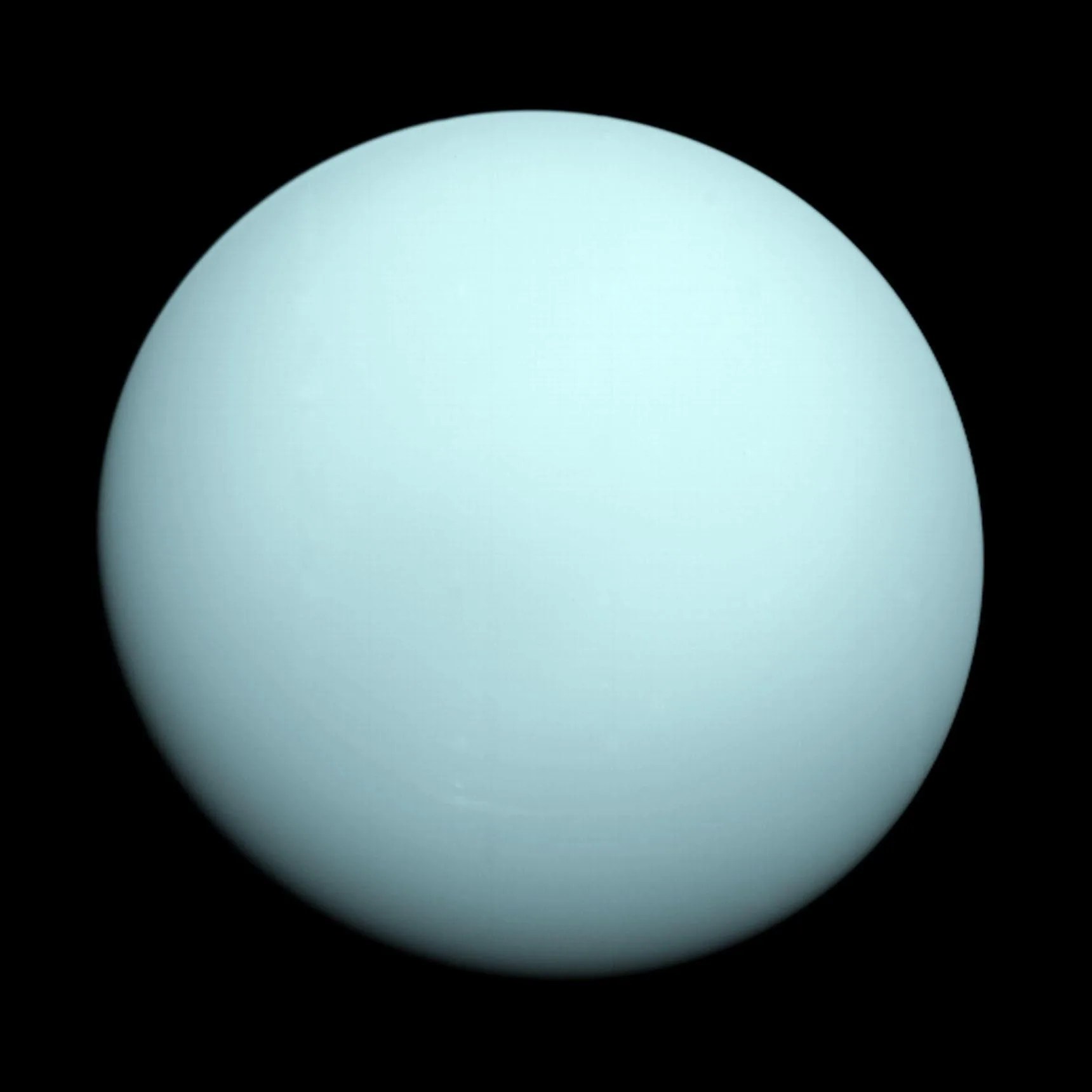
For decades at a time, one pole faces sunlight while the other faces darkness.
Uranus rotates at nearly a right angle to its orbit. A giant impact is one possible origin, but the exact history must also explain its moons, rings, internal heat and unusual magnetic field.
OBSERVEDA 97.77-degree axial tilt and extreme seasonal geometry
INTERPRETEDA violent or complex early dynamical history
NOT PROVENOne unique collision scenario that explains the entire system
The planet's calm Voyager-era appearance was a snapshot; later telescopes reveal changing clouds and seasonal activity.
QUICK PLANET PROFILE
Build the world before chasing the mystery.
Use these values as orientation, then follow the linked mission files when precision matters.
POSITION7th planet
The first planet discovered with a telescope.
YEAR84 Earth years
Each season lasts roughly two decades.
DAYAbout 17.2 hours
The interior rotates while the planet lies nearly sideways.
RADIUS25,362 km
Roughly four Earth radii and classed as an ice giant.
TILT97.77 degrees
Its extreme geometry creates unusual sunlight and seasons.
VISITSOne spacecraft flyby
Voyager 2's 1986 encounter still anchors direct knowledge.
OFFICIAL MISSION FILES
Wonder with the source still attached.
Each briefing separates measurement from interpretation and links to NASA or ESA material. Open the source whenever a claim matters.
01 · SEASONS
A year lasts 84 Earth years
The extreme tilt exposes each pole to long periods of sunlight and darkness over Uranus's orbit.
A useful science page should not end by pretending the mystery is closed.
QUESTION 01
What knocked Uranus sideways?
Any origin must explain the planet, moons, rings, spin and internal structure together.
NEXT EVIDENCE
An orbiter's gravity, composition and satellite-system measurements.
QUESTION 02
Why does Uranus emit so little internal heat?
Neptune is similar in size yet radiates much more energy.
NEXT EVIDENCE
Atmospheric entry data and long-duration thermal mapping.
QUESTION 03
Could its moons hide oceans?
Fractured surfaces and thermal models make some midsized moons compelling targets.
NEXT EVIDENCE
Close imaging, gravity, magnetic and composition measurements.
FIELD NOTES
Four details worth carrying into the next room.
An ice giant is hot inside; the name refers to composition, not a frozen surface.
The pale Voyager image was a seasonal and instrumental snapshot.
The magnetic field is both tilted and offset from the center.
One flyby cannot provide a full seasonal record.
PLANETARY READING ROOM
Read Uranus as evidence, not as a collection of trivia.
These original briefings combine mission data, peer-reviewed research and clearly labelled interpretation. They are written for Kodmart; the linked records remain the authority when precision matters.
01
A SINGLE FLYBY PROBLEM
Much of what we call normal at Uranus may describe one unusual week in 1986.
Voyager 2 transformed a point of light into a system, but timing and solar-wind conditions limit the snapshot.
Voyager encountered Uranus near solstice, when its extreme axial tilt produced unusual illumination. The spacecraft also sampled a magnetosphere compressed by strong solar-wind conditions. Those measurements are real; the question is whether they represent the system's typical state.
Reanalysis suggests that some apparently exceptional plasma conditions may have been transient. That matters for theories about energy, radiation and possible oceans inside major moons. A future orbiter would replace one trajectory with observations across rotation, changing solar wind and seasons.
A precise measurement can still be unrepresentative.
The upper atmosphere offers a new way to study an ice giant's energy balance.
Webb spectroscopy can map faint ion emission that Voyager could only sample along one path.
Uranus radiates surprisingly little internal heat compared with Neptune, even though the planets are similar in size. Energy also moves through an atmosphere and ionosphere shaped by an extreme magnetic geometry. Measuring temperature and charged-particle density with height helps separate those processes.
Webb observations have mapped Uranus's upper atmosphere across nearly a full rotation, revealing vertical structure far above the cloud tops. They add an important remote-sensing record, but they cannot replace an entry probe or orbiter for noble gases, gravity and direct magnetic sampling.
Similar size does not imply identical internal heat flow.
Spectroscopy maps conditions through emitted molecular light.
Remote sensing and in-situ sampling answer different questions.