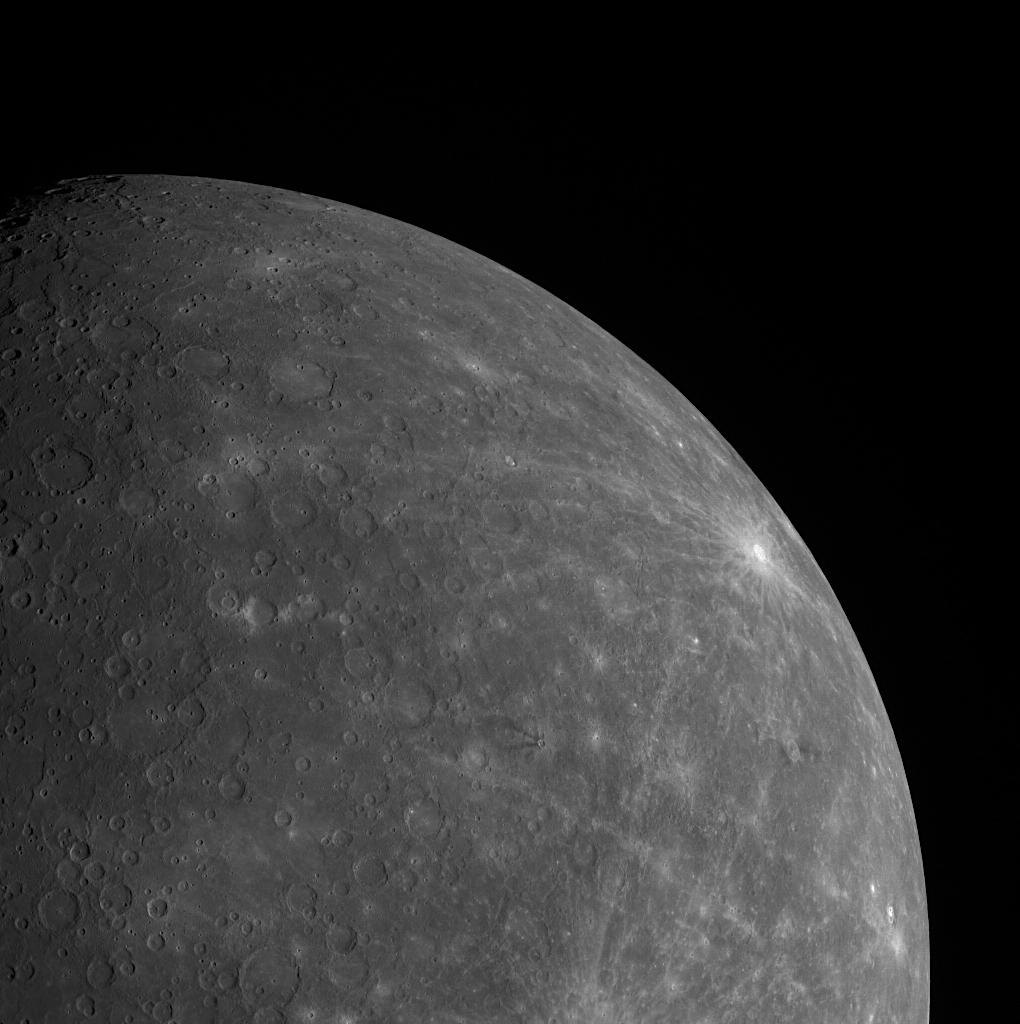
Sunlight can blaze nearby while water ice survives for billions of years.
MESSENGER radar and neutron measurements support water ice inside craters that never receive direct sunlight. The result is a lesson in local conditions: distance from the Sun alone does not determine what can survive on a planet.
OBSERVEDBright radar deposits and hydrogen-rich polar material
INTERPRETEDWater ice protected by permanent shadow
NOT PROVENOne unique delivery source or a single age for every deposit
The evidence supports polar volatiles; it does not turn Mercury into a habitable world.
QUICK PLANET PROFILE
Build the world before chasing the mystery.
Use these values as orientation, then follow the linked mission files when precision matters.
POSITION1st planet
The innermost orbit and fastest trip around the Sun.
YEAR88 Earth days
Mercury completes four years in roughly one Earth year.
SOLAR DAY176 Earth days
Sunrise to sunrise lasts twice a Mercurian year.
RADIUS2,440 km
The smallest planet, only a little larger than Earth's Moon.
MOONS0
Mercury has neither moons nor rings.
SURFACERock and metal
A cratered crust surrounds an unusually large metallic core.
OFFICIAL MISSION FILES
Wonder with the source still attached.
Each briefing separates measurement from interpretation and links to NASA or ESA material. Open the source whenever a claim matters.
01 · ORBIT
A year in only 88 Earth days
Mercury moves faster around the Sun than any other planet, yet rotates so slowly that one solar day lasts 176 Earth days.
A useful science page should not end by pretending the mystery is closed.
QUESTION 01
Why is the core so large?
Its metal-rich interior preserves clues to violent impacts, evaporation or unusual formation material.
NEXT EVIDENCE
Improved gravity, rotation and composition measurements.
QUESTION 02
How did polar water arrive and survive?
The ice records delivery by comets, asteroids or chemistry on a world close to the Sun.
NEXT EVIDENCE
Higher-resolution maps of volatile layers and their ages.
QUESTION 03
What creates the bright hollows?
These young depressions imply that volatile material still escapes from exposed rocks.
NEXT EVIDENCE
Mineralogy and repeat imaging of active-looking terrain.
FIELD NOTES
Four details worth carrying into the next room.
Look for the difference between a rotation period and a solar day.
Permanent shadow can be colder than the planet's average distance suggests.
Enhanced-color maps reveal composition; they are not natural-eye views.
A magnetic field is evidence about the interior, not an atmosphere.
PLANETARY READING ROOM
Read Mercury as evidence, not as a collection of trivia.
These original briefings combine mission data, peer-reviewed research and clearly labelled interpretation. They are written for Kodmart; the linked records remain the authority when precision matters.
01
CLOSE TO THE SUN
Mercury is shaped by heat, shadow and a relentless particle wind.
The smallest planet is not a simple scorched rock. Its surface, exosphere and magnetic bubble are continuously connected.
Mercury has almost no atmosphere in the terrestrial sense. Instead, atoms released from the surface form a thin exosphere that can be replenished by sunlight, solar-wind particles and micrometeoroid impacts. That makes the space around Mercury part of the geology: material can be knocked from rock, transported, measured and sometimes lost.
Its magnetic field creates a compact magnetosphere squeezed by the nearby solar wind. A short flyby can sample boundaries and particles, but only coordinated measurements through time can reveal which conditions are typical. BepiColombo therefore carries two orbiters designed to observe the planet and its environment from complementary positions.
Exosphere does not mean breathable atmosphere.
A magnetic field links the deep interior to the solar wind.
Every crater is also a clock, a cross-section and a record of resurfacing.
Impact scars dominate the view, but volcanic plains, scarps and volatile-loss hollows preserve a more complicated history.
Planetary geologists do not read an image as decoration. They map which unit crosses another, count craters, compare color and topography, and connect landforms to the forces that could build them. A global map is therefore an argument about relative time, not merely a labeled photograph.
Mercury's enormous metallic core also changed the surface as the planet cooled. Long cliffs record crustal shortening, while smooth plains preserve volcanic resurfacing. Polar radar-bright deposits add a different kind of archive: volatile material protected in places where sunlight never reaches the ground.
A geologic map separates observed units from an interpreted history.
Crater counts estimate relative age and retain uncertainty.
Permanent shadow creates local conditions unlike the global average.
Every planet and the deep-space flight opens a separate sourced reading mission. Distances and sizes in the cockpit remain visually compressed.
MISSION STATUS · KNOWLEDGE REMAINS OPEN
Mercury is not a burned-out Moon.
It is a differentiated planet with ice, a magnetic field, volatile-loss landforms and a history that can test how rocky planets form close to their stars.