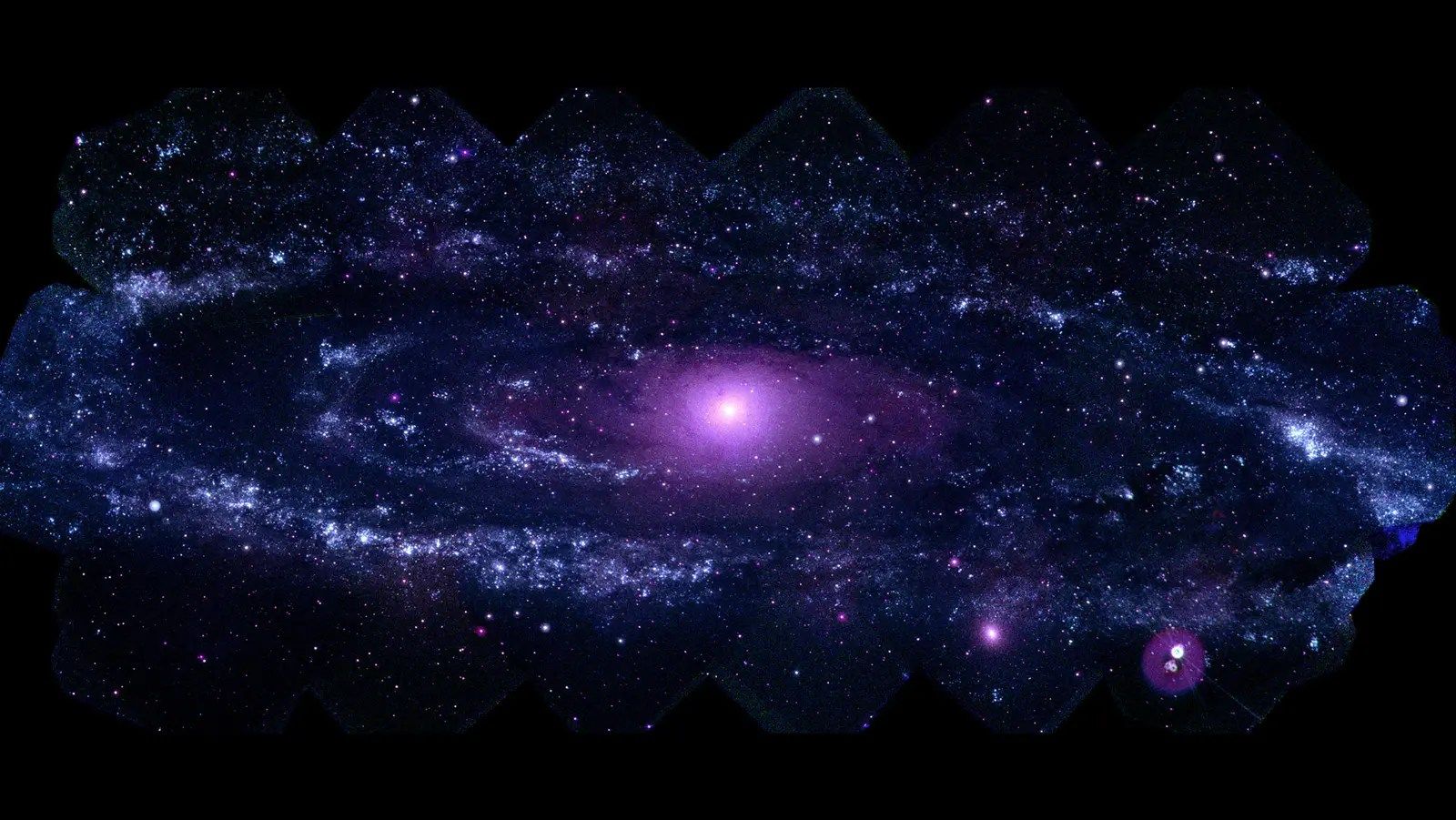
Leave the Solar System scale behind and travel through galaxies, clusters, voids and the cosmic web without pretending that a visual simulation is a map of every object.
Galaxies gather along filaments around enormous voids.
Gravity amplifies small early differences in matter density. Over cosmic time, galaxies and clusters assemble into threadlike filaments, intersections and walls separated by vast low-density regions.
OBSERVEDGalaxy positions, clusters, lensing and background radiation
INTERPRETEDA growing large-scale web shaped by gravity and cosmic expansion
NOT PROVENThe nature of dark matter or dark energy from one image
The cockpit flight is an educational visual compression. Distances, colors, object sizes and travel speed are not to scale.
QUICK PLANET PROFILE
Build the world before chasing the mystery.
Use these values as orientation, then follow the linked mission files when precision matters.
HOME GALAXYMilky Way
A barred spiral more than 100,000 light-years across.
NEIGHBORHOODLocal Group
The Milky Way, Andromeda and dozens of smaller galaxies.
LOOK-BACKLight is history
Distant objects are observed as they were when their light began traveling.
STRUCTURECosmic web
Galaxies gather in groups, clusters, filaments, walls and voids.
INVISIBLEDark components
Gravity and expansion imply matter and energy not explained by luminous objects alone.
SIMULATIONNot to scale
The cockpit compresses distance, size, color and travel time for learning.
OFFICIAL MISSION FILES
Wonder with the source still attached.
Each briefing separates measurement from interpretation and links to NASA or ESA material. Open the source whenever a claim matters.
01 · GALAXIES
Islands with billions of stars
Galaxies contain stars, gas, dust and dark matter in forms ranging from spirals to ellipticals and irregular systems.
A useful science page should not end by pretending the mystery is closed.
QUESTION 01
What is dark matter?
Its gravity helps organize galaxies and the cosmic web, yet its particle nature remains unknown.
NEXT EVIDENCE
Lensing, galaxy dynamics, structure maps and particle experiments.
QUESTION 02
Why is cosmic expansion accelerating?
Dark energy is a name for an observed effect, not a complete physical explanation.
NEXT EVIDENCE
More precise distance, structure and expansion measurements through time.
QUESTION 03
How did the first galaxies grow?
Early structure connects the first stars and black holes to the mature galaxies seen nearby.
NEXT EVIDENCE
Deeper spectra, lensing and simulations tested against young galaxies.
FIELD NOTES
Four details worth carrying into the next room.
Every deep image combines wavelength, exposure, processing and look-back time.
A visualization may show invisible matter to explain structure; its colors need a legend.
The observable universe is not necessarily the whole universe.
A galaxy image can contain light emitted before Earth existed.
PLANETARY READING ROOM
Read Deep space as evidence, not as a collection of trivia.
These original briefings combine mission data, peer-reviewed research and clearly labelled interpretation. They are written for Kodmart; the linked records remain the authority when precision matters.
01
THE COSMIC WEB
Galaxies are not scattered randomly; they trace an evolving network.
Clusters, filaments and voids turn a sky full of points into a history of gravity and expansion.
Matter gathers into a cosmic web with dense knots, long filaments and immense underdense regions. Galaxies make part of that structure visible, while gravitational lensing helps infer mass that emits little or no light. The image is therefore not just a census of galaxies but a map of how gravity organized matter.
ESA's Euclid mission combines wide imaging with spectroscopy to place galaxies in three dimensions and study how structure changed through cosmic time. Redshift supplies distance information statistically, while galaxy shapes reveal weak distortions produced by matter along the line of sight.
Dark matter is inferred through gravitational effects, not photographed directly.
Redshift and distance are connected through a cosmological model.
A wide survey answers questions that one deep image cannot.
A distant image is also a time machine with an instrument attached.
The farther light travels, the earlier the universe we observe — but wavelength, selection and processing shape the view.
A deep field gathers faint light over long exposures and often combines filters into a color image. Galaxies at different distances appear together even though their light left at different cosmic times. Dust, expansion and detector sensitivity determine which objects become visible.
Webb extends deep-field work in infrared, while Euclid surveys far larger areas and Hubble provides a long, sharp optical archive. Their observations are complementary rather than a contest for the single best picture. Spectra, not appearance alone, are needed to estimate composition, motion and distance.
Astronomical color can encode invisible wavelengths.
A beautiful image is processed data and needs a legend.
Every planet and the deep-space flight opens a separate sourced reading mission. Distances and sizes in the cockpit remain visually compressed.
MISSION STATUS · KNOWLEDGE REMAINS OPEN
Deep space is not an empty backdrop.
It is a record of structure growing through time. Every image mixes the object, the instrument, the wavelength and the look-back time, so the source must stay attached to the wonder.