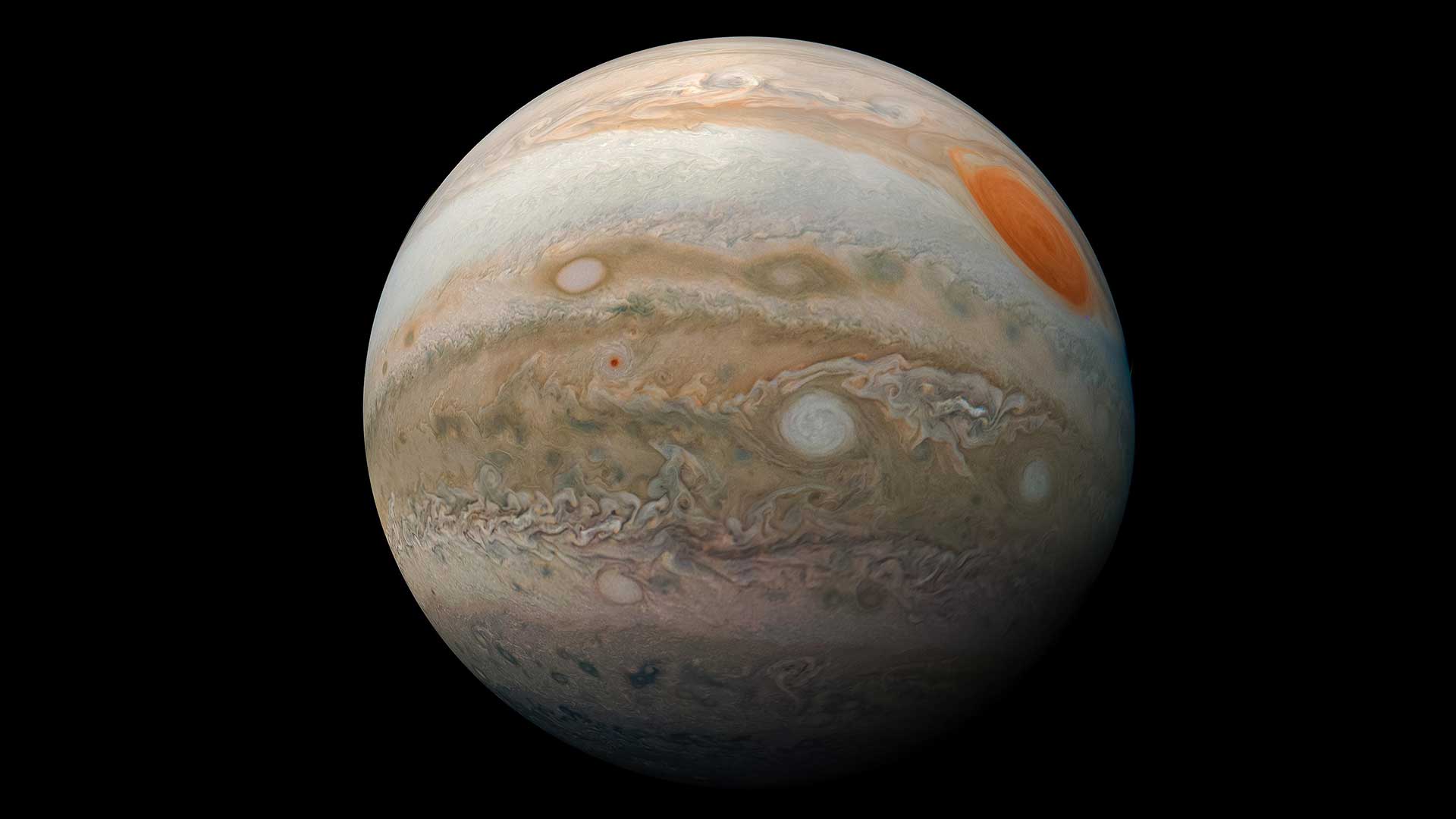
The visible clouds are only the top of a planet without a solid surface.
Juno gravity and microwave measurements show that jets and storms extend below the cloud tops. The Great Red Spot is immense but not an infinitely deep column; its structure changes with depth.
OBSERVEDDeep jet signatures, powerful storms and complex gravity
INTERPRETEDWeather coupled to a fluid interior without a hard boundary
NOT PROVENA simple solid core or one settled model of the deep interior
Jupiter itself is hostile to known life; the astrobiological interest lies especially in moons such as Europa.
QUICK PLANET PROFILE
Build the world before chasing the mystery.
Use these values as orientation, then follow the linked mission files when precision matters.
POSITION5th planet
The first planet beyond the asteroid belt.
YEAR11.86 Earth years
Its slow orbit contrasts with the fastest planetary rotation.
DAY9.9 hours
Rapid rotation organizes jets, bands and a flattened shape.
RADIUS69,911 km
About eleven Earth radii and the Solar System's largest planet.
SURFACENo solid boundary
Gas compresses into fluid and electrically conducting hydrogen.
SYSTEMPlanet, rings and moons
The giant controls a diverse miniature planetary system.
OFFICIAL MISSION FILES
Wonder with the source still attached.
Each briefing separates measurement from interpretation and links to NASA or ESA material. Open the source whenever a claim matters.
01 · SCALE
More massive than all other planets combined
Jupiter is the solar system's largest planet and could contain roughly 1,000 Earths by volume if imagined as a hollow shell.
Repeated polar maps and models connecting depth to visible motion.
QUESTION 03
Can Europa support habitable chemistry?
A salty ocean, rock-water interaction and surface exchange could supply key ingredients.
NEXT EVIDENCE
Europa Clipper measurements of ice, ocean, composition and geology.
FIELD NOTES
Four details worth carrying into the next room.
Visible bands are the top of a much deeper fluid system.
Jupiter's moons are separate worlds, not minor accessories.
Radiation is part of the environment and shapes spacecraft design.
A potentially habitable ocean is not evidence that life exists there.
PLANETARY READING ROOM
Read Jupiter as evidence, not as a collection of trivia.
These original briefings combine mission data, peer-reviewed research and clearly labelled interpretation. They are written for Kodmart; the linked records remain the authority when precision matters.
01
BELOW THE CLOUDS
Jupiter's weather has depth, but scientists are still locating the machinery.
Gravity, microwaves and visible motion reveal a layered fluid planet rather than weather painted onto a surface.
Jupiter's colored belts and storms are the visible ceiling of a much deeper atmosphere. Juno measurements show that multiple jet streams extend thousands of kilometers downward before their behavior changes. The Great Red Spot also has measurable depth, yet no solid floor anchors it.
The remaining problem is not simply how fast the clouds move. Scientists want to know where jets gain energy, how they are slowed, how water and ammonia are distributed and how the atmosphere joins the electrically conducting interior. Each measurement constrains a different layer of that system.
Cloud-top motion does not reveal the full depth by itself.
Gravity can detect mass patterns hidden below visible clouds.
A gas giant transitions into fluid without a walkable surface.
The moons turn Jupiter from one planet into a laboratory of environments.
Io exports volcanic material, icy moons may hide oceans, and Jupiter's magnetic field connects them all.
Io's eruptions supply charged particles to Jupiter's environment. Europa, Ganymede and Callisto are each thought to contain liquid-water layers beneath ice, but their shells, chemistry, geology and contact with rock differ. The word ocean therefore does not imply identical habitability.
ESA's Juice mission will observe the giant planet and its moons as an interacting system, with particular emphasis on Ganymede. Its measurements will complement Europa Clipper rather than produce a simple yes-or-no life detector. The mission asks whether the physical and chemical conditions for habitable environments can be established.
An ocean is one condition, not proof of life.
Radiation both alters surfaces and complicates measurement.
Comparing moons is more informative than treating them as copies.