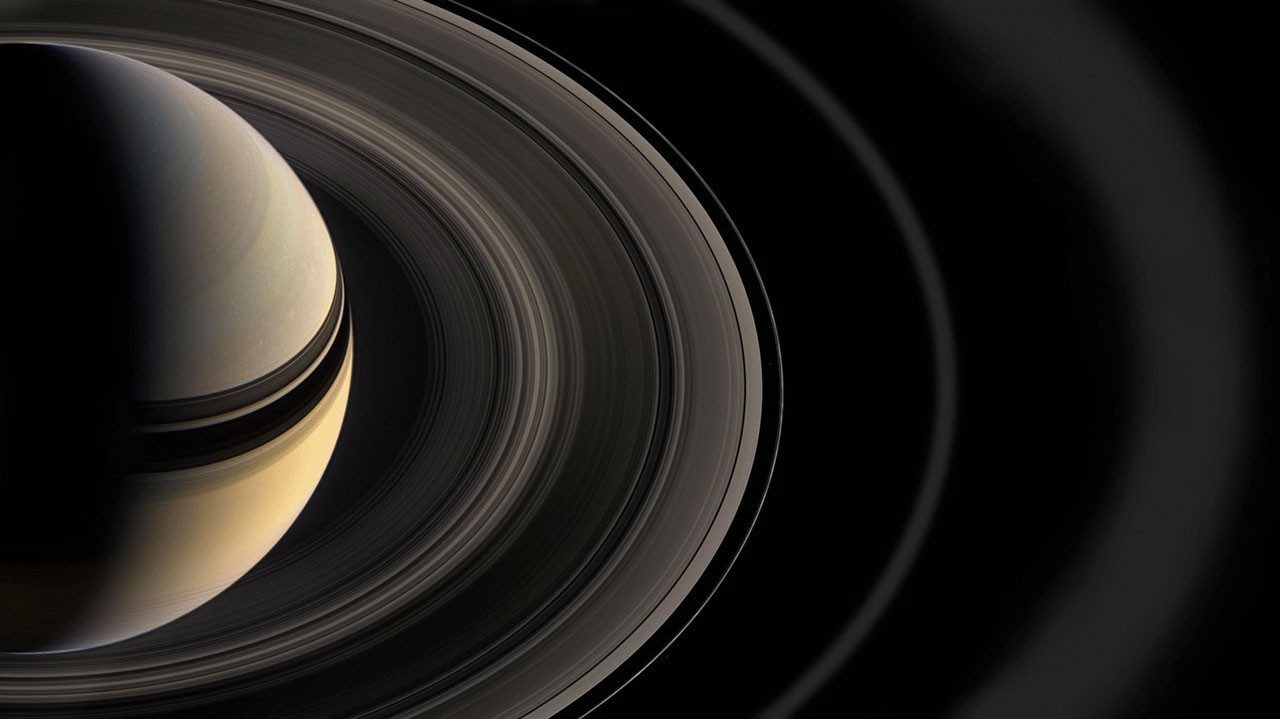
Saturn ring system · NASA/JPL-Caltech/Space Science Institute
PRIMARY SYSTEM · RINGS AND MOONS
A moon can feed a ring while the ring records invisible forces.
Cassini found that water-rich jets from Enceladus supply much of Saturn's diffuse E ring. Ring waves and structures also respond to moons and to oscillations inside Saturn, turning the system into a remote sensing instrument.
OBSERVEDIcy particles, ring waves and Enceladus plume material
INTERPRETEDAn evolving system exchanging material and momentum
NOT PROVENOne simple age or origin story for every ring component
The rings are mostly ice particles; their beauty does not make them a solid platform or a single unchanging object.
QUICK PLANET PROFILE
Build the world before chasing the mystery.
Use these values as orientation, then follow the linked mission files when precision matters.
POSITION6th planet
The second gas giant and the most conspicuous ring system.
YEAR29.4 Earth years
Long seasons change the atmosphere, rings and viewing geometry.
DAYAbout 10.7 hours
Rapid rotation drives bands, winds and an oblate shape.
RADIUS58,232 km
More than nine Earth radii, but with very low average density.
RINGSIce-rich particles
Countless fragments form thin, structured disks rather than one solid plate.
SYSTEMOcean and methane worlds
Enceladus and Titan make Saturn a multi-world laboratory.
OFFICIAL MISSION FILES
Wonder with the source still attached.
Each briefing separates measurement from interpretation and links to NASA or ESA material. Open the source whenever a claim matters.
01 · PLANET
A low-density gas giant
Saturn is the second-largest planet and has the lowest average density of any planet, though it has no ocean in which it could float.
A useful science page should not end by pretending the mystery is closed.
QUESTION 01
How old are the main rings?
Mass, pollution and erosion measurements support competing formation histories.
NEXT EVIDENCE
Better models of ring evolution, impact rates and material exchange.
QUESTION 02
What powers Enceladus for so long?
Persistent heat sustains an ocean and plume in a small moon.
NEXT EVIDENCE
More precise gravity, chemistry and long-term plume sampling.
QUESTION 03
How complex is Titan's chemistry?
Organic molecules, methane weather and a buried ocean connect atmosphere and surface.
NEXT EVIDENCE
Mobile in-situ exploration across multiple terrains.
FIELD NOTES
Four details worth carrying into the next room.
The rings are extremely broad but remarkably thin.
Ring color and brightness depend on particle size, composition and lighting.
Enceladus plume samples came from an ocean without drilling.
Titan's lakes contain hydrocarbons, not liquid water at the surface.
PLANETARY READING ROOM
Read Saturn as evidence, not as a collection of trivia.
These original briefings combine mission data, peer-reviewed research and clearly labelled interpretation. They are written for Kodmart; the linked records remain the authority when precision matters.
01
THE RINGS AS AN INSTRUMENT
Saturn's rings record gravity, impacts and material exchange in moving patterns.
The rings are not a rigid emblem. They are a thin, evolving disk made of countless orbiting particles.
Ring gaps, waves and sharp edges can be forced by moons whose gravity repeatedly tugs particles at particular orbital rhythms. Other structures respond to impacts, electromagnetic effects and material supplied by Enceladus. Reading the rings is therefore a form of remote sensing.
Cassini observed the system across changing seasons and finally passed between the planet and rings. Even after thirteen years, major questions remain about ring age, mass and recycling. A bright, clean-looking ring can be compatible with more than one formation history.
The rings are broad but extraordinarily thin.
A wave can reveal an unseen gravitational influence.
Appearance alone cannot settle the age of the system.
Enceladus lets a spacecraft sample an ocean without drilling through ice.
Plume grains connect an unseen sea to laboratory instruments — while habitability remains distinct from inhabited.
Cassini flew through material escaping from Enceladus and detected salts and organic compounds. Some grains enter Saturn's E ring, allowing repeated measurements of ocean-derived material. This is unusually direct access to the chemistry of a subsurface ocean.
A peer-reviewed analysis identified sodium phosphates in salt-rich grains and combined those observations with laboratory analogues and geochemical modeling. Phosphorus is important to known biology, but its presence does not demonstrate organisms. The result strengthens a chemical habitability case and sharpens the questions for a future mission.
Plume material can carry information from an inaccessible ocean.
A bio-essential element is not a biosignature.
Laboratory analogues help interpret spectra but retain model assumptions.